Circuit-modeled analog filter
FILTRONIX
Free
Circuit-modeled analog filter — completely free.
Windows VST3 / macOS AU & VST3Version 1.2.0 adds a resizable interface and includes bug fixes.
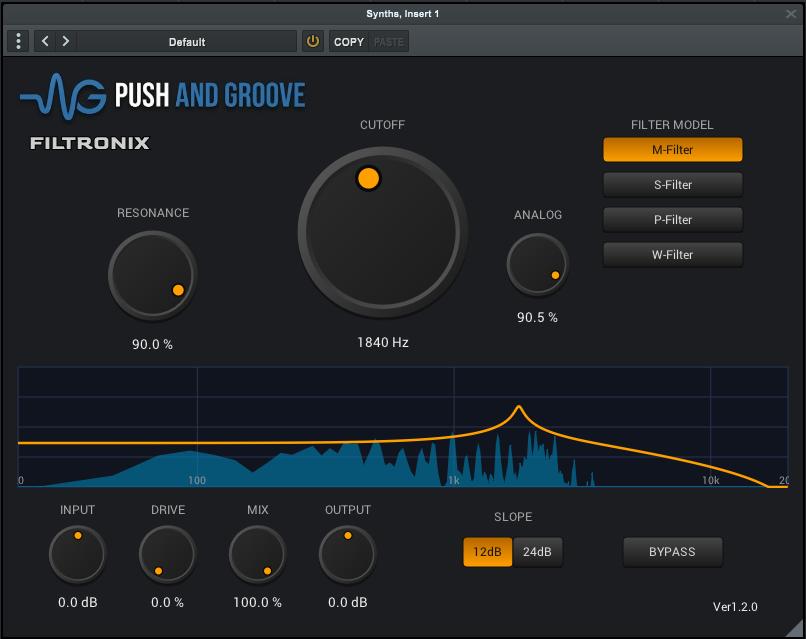
Analog character without losing control.
FILTRONIX combines circuit-inspired filtering with modern DSP techniques for smooth resonance, controllable drive, and practical mix-ready operation.
Model the behavior
Filter topology, feedback, saturation, and resonance interact as one system instead of a stack of unrelated effects.
Keep resonance responsive
Zero-delay feedback topology supports smooth cutoff movement and stable behavior at high resonance.
Add tone with clarity
ADAA saturation and 4x oversampling help control aliasing while the Drive stage adds weight and edge.
See the filter move
The spectrum and response display make cutoff, resonance, and tonal changes easy to follow.
Four circuits. Four personalities.
Switch filter character without rebuilding your processing chain.
Transistor ladder
A pronounced resonant peak with the familiar musical low-end movement of a classic ladder response.
Classic state variable
A thick, focused response that keeps weight around strong resonance and near self-oscillation.
Polyphonic OTA
A fat and punchy cascade character inspired by the sound of classic polyphonic instruments.
British CMOS
An unstable, aggressive response with sudden resonance and a distinctly raw circuit character.
Why ZDF / TPT matters.
The feedback loop is central to how an analog filter responds when cutoff and resonance are pushed.
A digital compromise
A unit delay inside the feedback path can change the response and make extreme resonance feel less connected.
A tighter circuit response
ZDF / TPT solves the feedback relationship within the current sample for smoother control and more analog-like interaction.
Analog movement, not static perfection.
The Analog control introduces subtle variation that makes the filter feel less mechanically identical from moment to moment.
- Cutoff drift: subtle movement around the selected frequency.
- Resonance variation: small changes in feedback behavior.
- Crosstalk: controlled interaction that adds width and imperfection.
- Input-sensitive saturation: more level produces more character.
Audio input
  |
Input + Drive
  |
Circuit-modeled ZDF filter
  |
ADAA saturation + oversampling
  |
Mix + Output
  |
Audio output
A practical filtering workflow.
Start clean, choose the circuit character, then add movement and drive only where the source needs it.
Choose a filter model
Start with M, S, P, or W according to the resonance shape and tonal weight you want.
Set cutoff, resonance, and slope
Shape the frequency range, then switch between 12dB and 24dB operation for a gentler or steeper response.
Add Drive and Analog
Push the nonlinear stage for tone, then add subtle movement without losing the core filter setting.
Level-match and compare
Use Output, Mix, and Bypass to compare the processed sound at a fair level.
Useful across modern production.
Use FILTRONIX as a precise tone shaper, a resonant sound-design tool, or a driven analog-style color stage.
Synths and keys
Shape bright oscillators, pads, and sequences with circuit-specific resonance and movement.
Drums and bass
Control upper-frequency energy while adding weight, drive, and rhythmic filter motion.
Loops and effects
Create sweeps, transitions, and unstable textures from static samples and effect returns.
Automation
Move cutoff and resonance with a responsive topology designed for musical modulation.
Controls and specifications.
- Product
- FILTRONIX Free
- Version
- 1.2.0
- Type
- Circuit-modeled low-pass filter effect
- Filter models
- M, S, P, W
- Topology
- Zero-Delay Feedback / TPT
- Slope
- 12dB / 24dB switchable
- Processing
- 4x oversampling, 33-tap FIR polyphase, ADAA saturation
- Controls
- Input, Drive, Mix, Output, Cutoff, Resonance, Analog, Model, Slope, Bypass
- Formats
- Windows VST3 / macOS AU & VST3
- Price
- Free download
Installation.
Install FILTRONIX in the standard plug-in folder for your platform, then rescan plug-ins in your DAW.
VST3
Copy the FILTRONIX VST3 bundle to the standard VST3 folder, then rescan in your host.
C:\Program Files\Common Files\VST3
AU & VST3
Follow the installation instructions included with your download. The standard system plug-in folders are:
/Library/Audio/Plug-Ins/Components
/Library/Audio/Plug-Ins/VST3
Check the included README for system requirements and installation instructions.
FAQ
What makes FILTRONIX different from a standard digital filter?
FILTRONIX models circuit-inspired feedback and nonlinear behavior, then combines it with ZDF / TPT topology, saturation, and oversampling.
Which filter model should I try first?
Start with M for a familiar ladder-style response, then compare S, P, and W at the same cutoff and resonance settings.
What does the Analog control change?
It adds subtle cutoff drift, resonance movement, crosstalk, and input-sensitive saturation for a less static response.
Why use 4x oversampling?
Oversampling gives nonlinear processing more internal bandwidth and helps reduce audible aliasing when Drive and resonance are pushed.
Is FILTRONIX free?
Yes. FILTRONIX Free is available for Windows VST3 and macOS AU & VST3.
Start filtering.
Download FILTRONIX and explore four circuit characters, nonlinear drive, and analog-style movement.
Go further with FILTRONIX PRO.
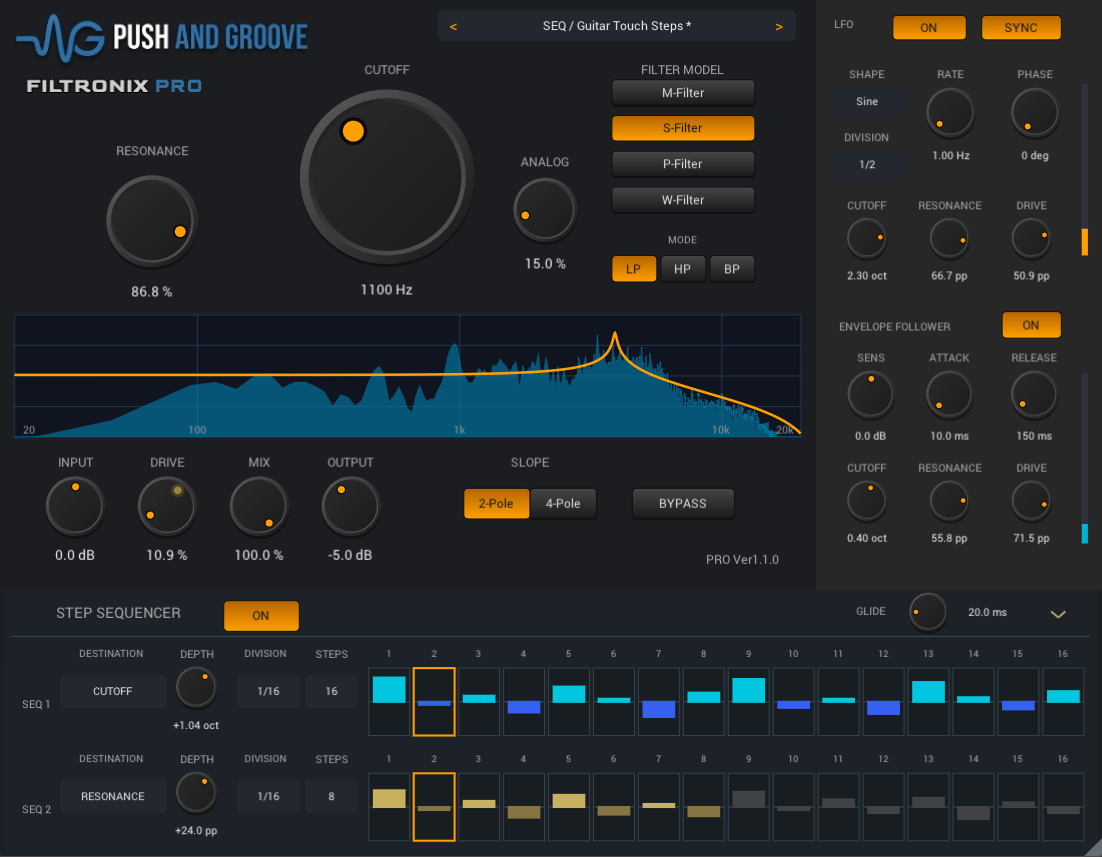
Want HP/BP filters, LFO and Envelope Follower? Add more filter modes and built-in motion to your sound.
More Plugins
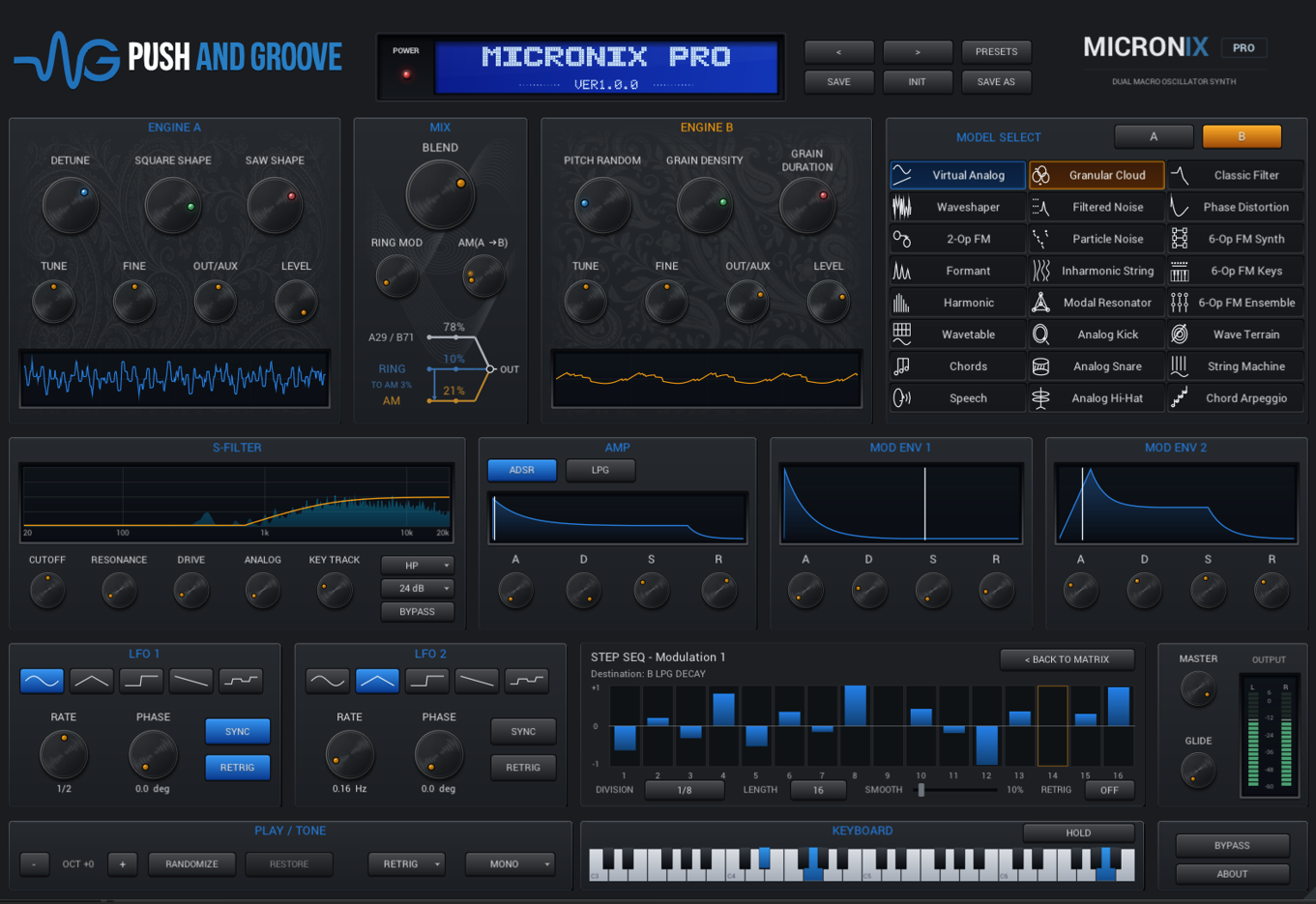



FILTRONIX is independently developed by Push and Groove. Third-party product and platform names belong to their respective owners. Copyright 2026 Push and Groove.